
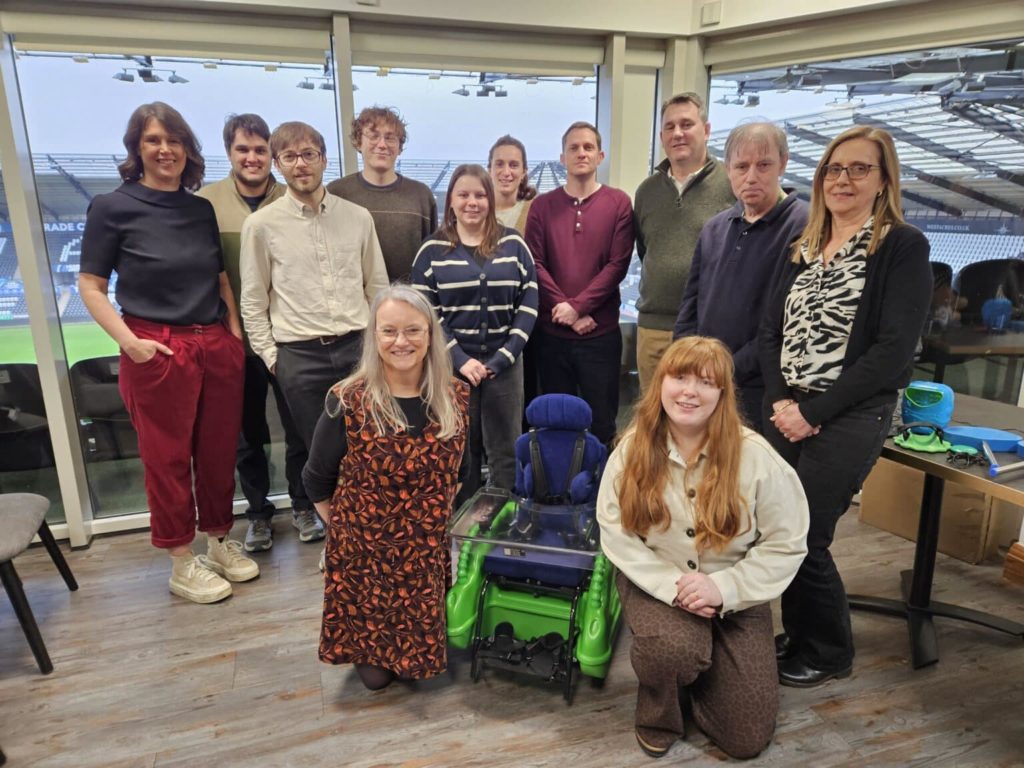
MERU nearly vanished. The specialist charity that built the Bugzi wheelchair and designed switch-adapted toys for disabled children was caught up in the collapse of QEF — a 90-year-old organisation whose closure in 2025 affected many services and thousands of people across the disability sector. Cerebra stepped in to rescue MERU’s work and keep these vital services available to families.
Here is what was saved, why it matters, and what families need to know.
Early mobility and accessible play can shape how disabled children interact with the world around them. The rescue of MERU’s specialist engineering work by Cerebra protects important services, including the Bugzi powered wheelchair loan scheme and the development of switch-adapted toys. These tools allow children with limited movement to explore their surroundings, experiment with cause and effect, and take part in play on their own terms. Drawing on research and personal experience of raising a child with complex needs, this article explains why early access to mobility and assistive technology matters, how families can access Cerebra services, and how practical solutions such as switches, mounting arms, and flexible trays can help children interact with toys, tablets, and sensory activities more independently.
Why early mobility and inclusive design matter for disabled children
| Key Insight | Why It Matters |
|---|---|
| Independent mobility supports cognitive and social development | Children learn about the world through movement, exploration, and interaction. |
| Switch-adapted toys allow children with limited movement to control play | Large accessible switches make it possible for children to activate toys and understand cause and effect. |
| The Bugzi powered wheelchair enables mobility from a young age | Children aged 1–6 can move independently during key stages of development. |
| Inclusive design centres work directly with disabled families | Co-design produces practical solutions based on real everyday barriers. |
| Cerebra’s rescue of MERU protects specialist disability innovation | Services and design expertise that might have been lost can continue supporting families. |
How Cerebra rescued MERU’s work
In late 2025, QEF entered administration after more than 90 years of operation. Rising employment costs following the 2024 Autumn Budget — including a rise in employer National Insurance to 15% — were among the financial pressures linked to a significant drop in income, from £14.6 million to £12.4 million in a single year.
The consequences for the MERU team were severe.
The administrators would not allow the MERU name to transfer to the new organisation, meaning the brand “MERU” itself has disappeared.
Tools and equipment were lost. The entire team was made redundant. Cerebra stepped in to bring the remaining six staff into the Cerebra Innovation Centre, and had to buy the Bugzi units back from the administrators directly — it was the only way to save the loan scheme.
The Bugzi name was the one thing the administrators allowed to be kept. Everything else — the MERU brand, the workshop tools, the infrastructure built over decades — went with the administration. Some staff left when redundancies were announced and did not return.
The timing made everything harder. QEF entered administration just one month before Christmas — the busiest period of the year for specialist disability equipment. Without the support of Inclusive Technology, who continued to sell MERU products during the crisis and kept income flowing to the team, the situation could have been far worse.
The team has now moved into new offices in Tadworth and is joining the existing Cerebra Innovation Centre staff in Wales, operating together as one expanded CIC team
As Cerebra Chief Executive Jess Camburn Rahmani put it in their official announcement:
“Cerebra and MERU share a steadfast belief that good design can bring inclusion, joy and adventure to disabled children and their families. We are stronger together.”
The rescue happened behind the scenes, under an NDA, one month before Christmas. The fact that anything survived at all is down to Cerebra moving fast when it mattered.
MERU timeline
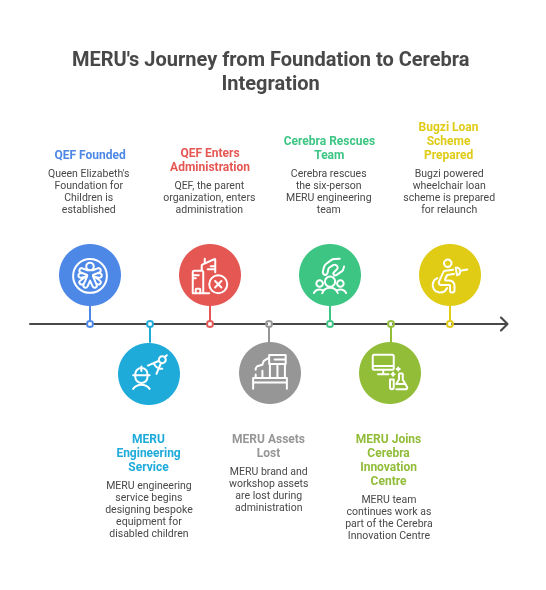
- 1935 – QEF founded
- 1990s – MERU engineering service established to design bespoke equipment for disabled children
- 2025 – QEF enters administration
- 2025 – MERU brand and workshop assets lost during administration
- 2025 – Cerebra rescues the six-person MERU engineering team
- 2026 – Team continues work as part of the Cerebra Innovation Centre
- 2026 – Bugzi powered wheelchair loan scheme prepared for relaunch
What makes the story more frustrating is that the MERU team was functioning well. The Bugzi loan scheme had a two-month waiting list. The workshop was busy. The team were caught in the collapse of a much larger organisation’s finances — not their own.
During the administration process the team were bound by a non-disclosure agreement and could not publicly ask for help or tell families what was happening. Behind the scenes, the groundwork to find a new home was being quietly laid — and two charities ultimately put in bids. Cerebra was chosen as the better fit for the team and the work they do.
The QEF collapse is also a wider warning. A 2025 Royal Society report found that 53% of disabled digital assistive technology users said they could not live the way they do without it — which makes the continuation of specialist services like these all the more critical.
What is the Bugzi powered wheelchair for young disabled children?
The Bugzi is a powered indoor wheelchair designed for young disabled children aged between one and six years old. It allows children who cannot walk independently to move around their home and interact with their surroundings.
Unlike standard wheelchairs designed for older users, the Bugzi is built for early childhood. It supports posture while allowing children to control movement using simple joystick controls. It is one of the few powered indoor wheelchairs designed specifically for this very young age group.
The Bugzi loan scheme is planned to return soon under Cerebra. Before the QEF collapse there was a two-month waiting list, so families are advised to register their interest with the Cerebra Innovation Centre as early as possible. The team are ready to move quickly — with Bugzi units already prepared in the workshop, families can expect the loan scheme to be back up and running in the coming weeks. A refundable deposit is required at the time of loan.
This early access to movement matters. During the first years of life, children learn through exploration — moving towards toys, people, and objects to build spatial awareness, social interaction, and communication skills.
Why independent mobility matters for child development
A 2025 study published in Frontiers in Rehabilitation Sciences found that powered mobility devices are significantly underused, despite strong evidence that independent exploration supports children’s cognitive, sensorimotor, social, and emotional development. The same research highlighted that children who cannot move independently risk falling into patterns of learned helplessness, reduced curiosity, and social isolation — outcomes that can become harder to reverse the longer they are left unaddressed.
One parent captured the difference simply: “His whole understanding of his surroundings has changed. He is getting into everything.” That shift — from passive observer to active explorer — is exactly what early mobility tools are designed to enable.
What are switch-adapted toys?
Switch-adapted toys are toys that can be activated using large accessible switches rather than small built-in buttons. The switch can be positioned wherever a child can reliably reach it — some children activate switches with their hands, while others may use their head, knee, or foot.
When the switch is pressed, it triggers the toy to perform an action such as lighting up, spinning, or playing music. For many disabled children, this is the first time they are able to control something independently during play. A peer-reviewed 2023 study in Child: Care, Health and Development found that access to switch-adapted toys significantly increased the range of independently accessible, cognitively appropriate play available to disabled children. Switch toys also serve as a gateway to AAC (augmentative and alternative communication) devices, building cause-and-effect understanding from an early age.
Where can families find switch-adapted toys in the UK?
Families looking for switch-adapted toys can access support through organisations such as the Cerebra Innovation Centre, specialist assistive technology suppliers, and local therapy services. These toys are often used alongside accessible switches, mounting arms, and tablets to help children explore cause-and-effect play and early communication.
Our experience using switches and sensory play
Our interest in switches started with our son. He has Dravet syndrome, and his seizures began when he was around three months old. Because of frequent seizures and developmental delay, he had very limited mobility and spent much of his time in a buggy or supportive seating.
We wanted to give him as many ways as possible to interact with his environment. Sensory play became an important starting point. Switches opened up new possibilities — instead of relying on small buttons or precise movements, he could activate toys using large switches placed within reach.
The challenge was mounting those switches safely. Traditional rigid trays were not suitable. Because of his seizures, there was a risk he could hit a hard surface if his body suddenly stiffened. Fixed trays were also difficult to attach and remove quickly in an emergency.
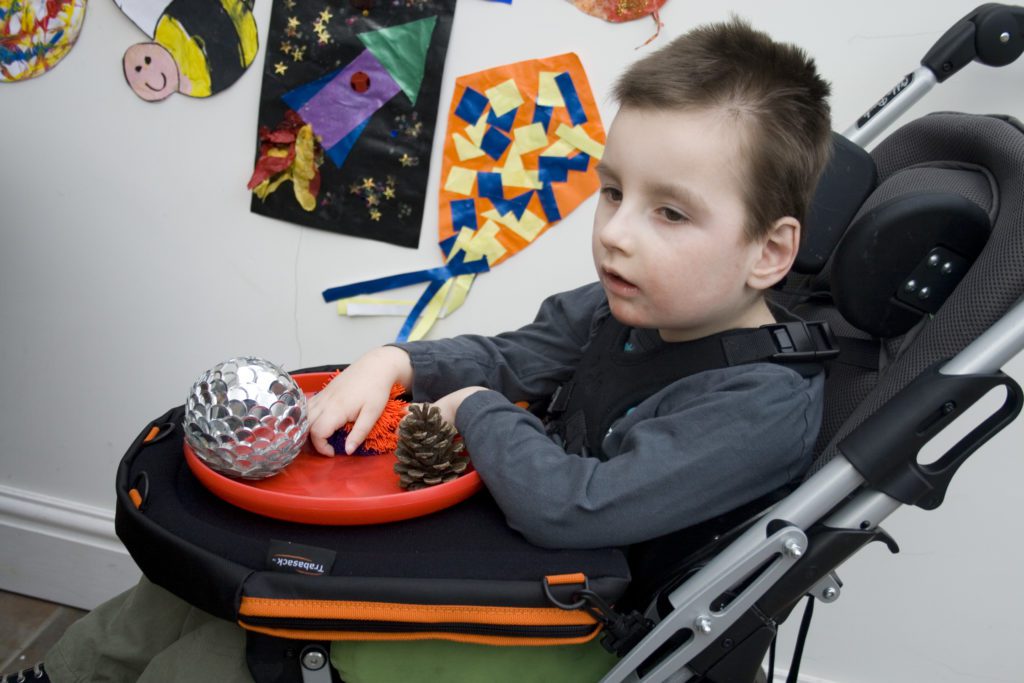
So my wife Clare made a simple solution at home. Using a sewing machine, she created an early version of what later became the Trabasack Curve Connect — with a tray insert made from the plastic lid of a cracker box, giving enough structure without rigidity. The fabric surface worked with hook tape so switches, toys, and sensory items could be attached securely but repositioned easily, placed exactly where he could reach them.
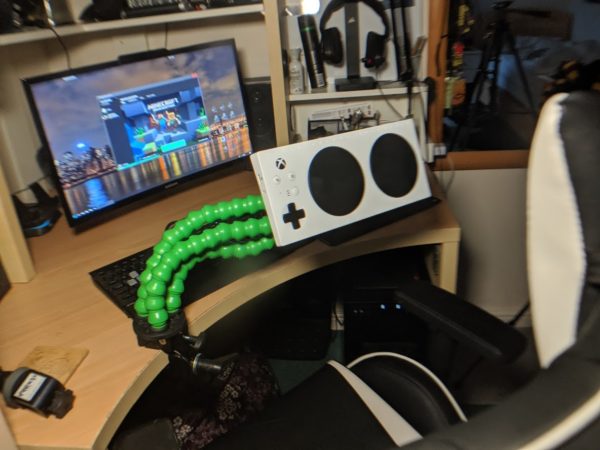
We also used a MERU Flexzi arm — a flexible mounting arm designed to hold switches or tablets in position — so an iPad could be securely attached to his wheelchair while remaining within easy reach for sensory apps that respond instantly to touch.
For children with limited movement, those small interactions matter enormously. Pressing a switch and making something happen is often the first time a child experiences genuine control over their environment. Those moments of independent action — however small — build curiosity, confidence, and the desire to interact further.
The Trabasack Curve Connect grew directly from those early experiments: a flexible surface where switches, tablets, and sensory
items can be positioned safely and repositioned as a child’s needs change.
Why disability-led design centres matter
Families often create their own solutions because many everyday products are not designed with disabled children in mind. Organisations such as the Cerebra Innovation Centre exist to support that kind of practical problem solving. Engineers work with families, therapists, and disabled children to design equipment that responds to real situations.
The Cerebra Innovation Centre’s work goes well beyond mobility aids. The team has created adapted surfboards, rocking horses, and Oxygems — bespoke equipment designed around individual children’s specific needs and circumstances. As Cerebra puts it, the goal is to ensure that “physical limitations never stand in the way of a child’s play or discovery.” That principle is exactly what the rescue of MERU’s work protects.
Disabled people and their families often understand the barriers they face better than anyone else. When design begins with those lived experiences, the results are more practical and more useful.
Another valuable resource is Remap, a UK charity that creates free, custom-made equipment for disabled people when nothing suitable exists commercially. Remap’s network of volunteer engineers works directly with disabled people and families to design and build one-off solutions tailored to a person’s exact needs — the same co-design principle that underpins the Cerebra Innovation Centre’s work.
How to access Cerebra Innovation Centre services
- Bugzi loan scheme: Contact the Cerebra Innovation Centre to register your interest — the scheme is returning soon and a waiting list is expected
- Bespoke equipment design: The CIC works with families to design one-off solutions for children with complex needs — get in touch directly with your child’s specific challenge
- Switch-adapted toy service: Now operating under Cerebra — contact the Innovation Centre for details
- General enquiries: Call Cerebra free on 0800 328 1159 or visit cerebra.org.uk
What about the MERU shop?
One question already being asked by families familiar with MERU is whether its online shop will return. The MERU shop was a well-used resource for accessible products including iPad cases, switch toys, and specialist equipment — often bought in bulk by schools, therapists, and carers.
Cerebra has confirmed that reopening the shop is the plan, but that it will take some time to set up properly. If you want to be kept informed:
- Sign up to the Cerebra newsletter at cerebra.org.uk/newsletter for general updates
- Email comms@cerebra.org.uk to be added to a MERU-specific mailing list
In the meantime, MERU products are currently available through Inclusive Technology, whose support during the administration period helped the team keep going through an incredibly difficult time.
The future of inclusive design for disabled children
Cerebra’s rescue of MERU’s work ensures that specialist design knowledge and services continue to reach families across the UK. But the collapse of QEF is a reminder of how fragile this ecosystem can be. The services that disabled children and their families rely on are not guaranteed — and the organisations that provide them need support to survive.
Early mobility devices such as the Bugzi and accessible play tools like switch-adapted toys give disabled children more opportunities to explore their surroundings. For many families, those early interactions are not just about play. They are about giving children ways to interact with the world on their own terms — and the evidence increasingly shows that the earlier that happens, the better the outcomes.
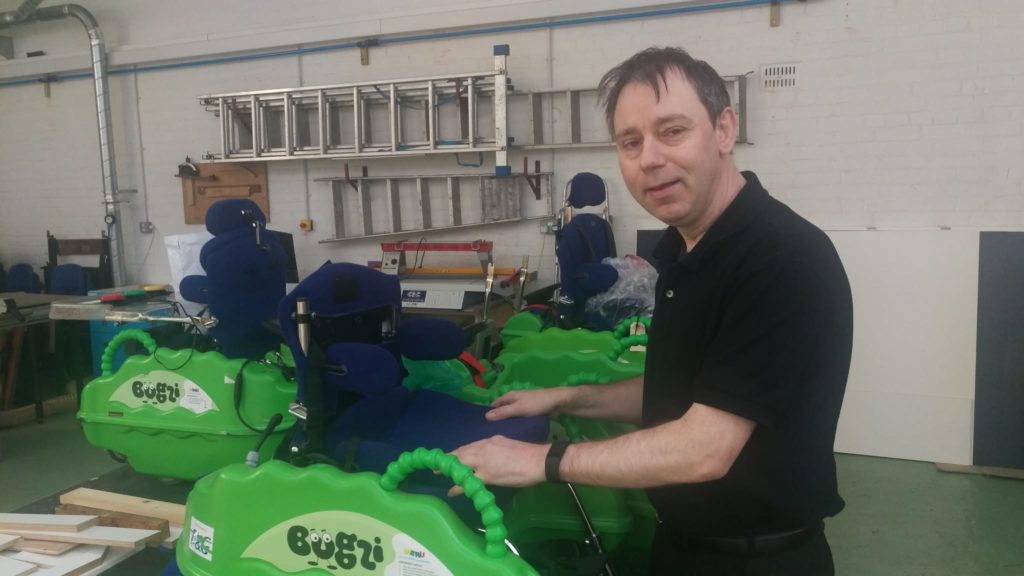
For Mark, one of three engineers now part of the Cerebra Innovation Centre team, the move to new offices in Tadworth this week marks a personal milestone. After years of working from home since the pandemic — and months of uncertainty during the administration — he is simply looking forward to getting out of the house and back into the
workshop. The team of six — three engineers and three in operations and management — are ready to get going again.
Frequently asked questions
What age is the Bugzi wheelchair designed for?
The Bugzi is designed for children aged 1 to 6 years old and is one of the few powered indoor wheelchairs made specifically for this age group.
How do I get a Bugzi for my child in the UK?
The Bugzi loan scheme is returning soon under Cerebra. A two-month waiting list is expected, so register your interest early with the Cerebra Innovation Centre. A refundable deposit is required.
What is a switch-adapted toy?
A switch-adapted toy is a toy modified to be activated by a large external switch, making it accessible to children with limited hand movement or fine motor control.
What happened to MERU?
MERU was a specialist engineering charity that designed bespoke equipment for disabled children. When its host organisation QEF entered administration in 2025, the MERU brand and tools were lost. Cerebra stepped in to bring the six-person team into the Cerebra Innovation Centre, buying back the Bugzi units from the administrators to save the loan scheme.
Can Cerebra design custom equipment for my child?
Yes. The Cerebra Innovation Centre works directly with families to design one-off bespoke solutions for children with complex needs. Contact them here to discuss your child’s situation.
Will the MERU shop reopen?
Cerebra has confirmed that reopening the shop is the plan. In the meantime, MERU products are available through Inclusive Technology. Email comms@cerebra.org.uk to be added to a mailing list for updates.
Author: Duncan Edwards is the shop manager at Disability Horizons and co-founder of Trabasack, an assistive product developed to help wheelchair users mount devices, switches, and activities safely. Duncan’s son has Dravet syndrome, which directly informs his work sourcing and developing disability products and services.