I know from experience that caring for a tube-fed child with complex medical needs means living in a permanent state of high alert. Every feed, every position change, every small routine is really about staying one step ahead of a medical emergency. I remember stretches of eight feeds a day, where missing one wasn’t an option, and the whole day simply revolved around the next feed. Writing a book is the furthest thing from your mind in a period of your life like that — you’re simply trying to get through the day safely.
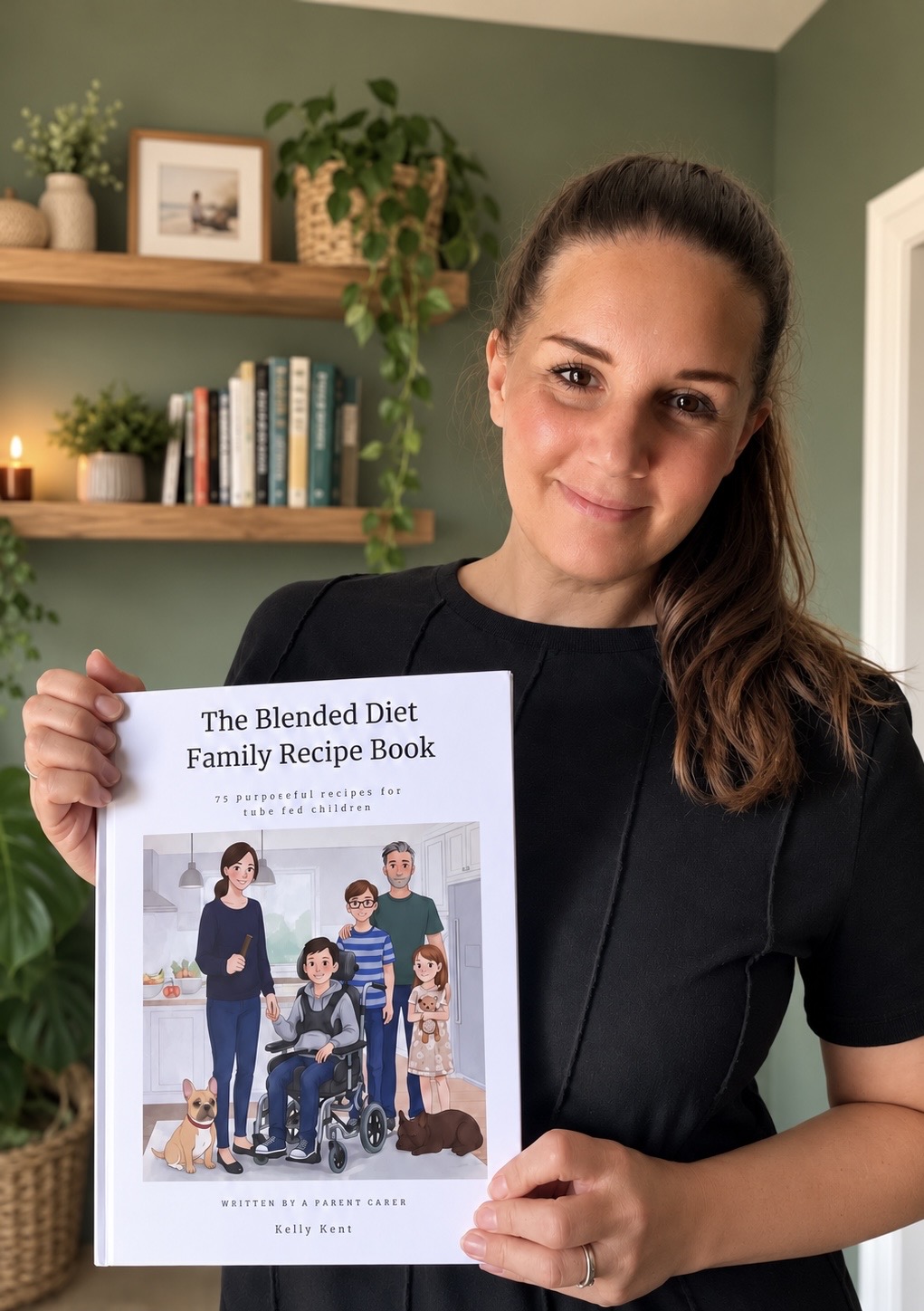
For Kelly Kent, that relentless vigilance — years of watching, adjusting and problem-solving to keep her son Mason safe while tube feeding — became the exact expertise that shaped an Amazon number one bestseller: The Blended Diet Family Recipe Book.*
Behind that book is a story that started long before Kelly ever thought about writing. Kelly is a mum of three from Kent, and her son Mason – now 10 – was born with profound disabilities following a brain injury at birth, living with cerebral palsy and epilepsy. Like so many parent-carers, she never imagined she’d become an expert in complex medical care. When you have a child with complex care, so much is out of your hands.
For Kelly, switching Mason to a blended diet handed some of that control back. “I was wholly responsible again for this aspect of his care,” she says. “Giving him a blended diet felt inclusive and natural”.
What Is Tube Feeding and a Blended Diet? Key Facts for Parents
If you’re new to this world, here’s a quick primer. Tube feeding, or enteral feeding, delivers nutrition directly into the stomach or intestine for children who can’t eat safely or sufficiently by mouth – often due to conditions like cerebral palsy, swallowing difficulties or neurological impairment. The two most common types are NG tubes (nasogastric, passing through the nose into the stomach, typically used short-term) and PEG (Percutaneous Endoscopic Gastrostomy) or G-tubes (gastrostomy, surgically placed through the abdomen).
| Topic | What Parents Should Know |
|---|---|
| Blended Diets | Real food delivered through a tube; best done with healthcare team input |
| Getting Started | Practice and trial-and-error are normal; practical guides fill the gap left by medical jargon |
| Kitchen Tips | Basic blenders work fine — focus on prep (soaking, steaming, tinned staples) |
| Handing Over Care | Written recipes help PAs and respite staff maintain routines confidently |
What the First Year of Tube Feeding Is Really Like
Kelly describes the first year after Mason’s birth as one of the hardest periods their family has faced.
“We had a new baby with profound disabilities, a toddler who was obviously also reliant on us for everything, and we somehow coped on very little sleep and lots of stress,”
Leaving hospital meant adjusting to life at home with a feeding tube, a stack of new diagnoses, and a diary already filling with appointments.

Feeding, she admits, was the part she hadn’t braced herself for.
“What I hadn’t anticipated is that feeding would be a big part of that stress. Tube feeding via an NG is a huge responsibility and it doesn’t come with a manual,”
What followed was years of learning by doing. “There was lots of trial and error over the next few years. Feeding stopped being something you did four or five times a day and became something that dominated nearly every waking hour”.
Managing Reflux, Positioning, and the Search for Real Food
Vomiting was a huge part of the daily struggle. “I would spend hours each day feeding Mason whilst stood up, with him in a sling or baby carrier, to let gravity keep his feeds down,” Kelly says. “But a seizure or a dystonic episode would undo that work in an instant”.
Watching other families feed their children real food through their tubes made her question why Mason couldn’t do the same.
“There was nothing wrong with his stomach, it was simply the way food was delivered that was different,” – Kelly
The Wake-Up Call: Nutrition Beyond Just Calories
For more than seven years, Kelly felt she was getting things right.
I felt I was doing a good job preparing blended meals for Mason. He was at a good weight and looked healthy,”
Then an iron deficiency diagnosis made her question that.
“I thought maybe I could improve on his blends and focus a bit more on different nutrients and vitamins”.
That moment reshaped her whole approach to meal planning. “What I soon realised was that his food could be vastly improved and I could tailor each meal to his specific needs,” she says. “We now concentrate on iron-rich ingredients, brain foods and recipes to help his gut function”.
Why a Dietitian Hasn’t Written a Blended Diet Recipe Book
Standard clinical advice for iron deficiency in tube-fed children tends to focus on supplementation and individual iron-rich foods, rather than on how combinations of foods might work together for better absorption.
Medical guidance prioritises safety and consistency across large patient populations. That leaves a gap for parents who want to go further with their child’s individual nutrition – exactly the space Kelly’s book tries to fill.
“There appeared to be a gap on the shelf for not only a blended diet recipe book, but one that is by a parent already living this journey, aimed specifically to help other parents,” – Kelly
What she’d found before writing her own book wasn’t much help. “Everything I had purchased in the past was text-heavy and read more like a medical journal”. She’s careful to note the book complements, rather than replaces, dietitian advice, with allergy guidance and reflux notes built into every recipe.
Blended Diet Recipes That Are Quick, Cheap and Realistic to Prepare
Blended meals don’t always match our usual ideas of what appealing food should look like and Kelly doesn’t try to disguise that.
“Choosing which foods to combine together can be just as important as the foods themselves, The blends might not always look pretty but they are carefully designed to make every ingredient count”
Most are built for batch cooking and storage — blending fitting around life, not the other way round.
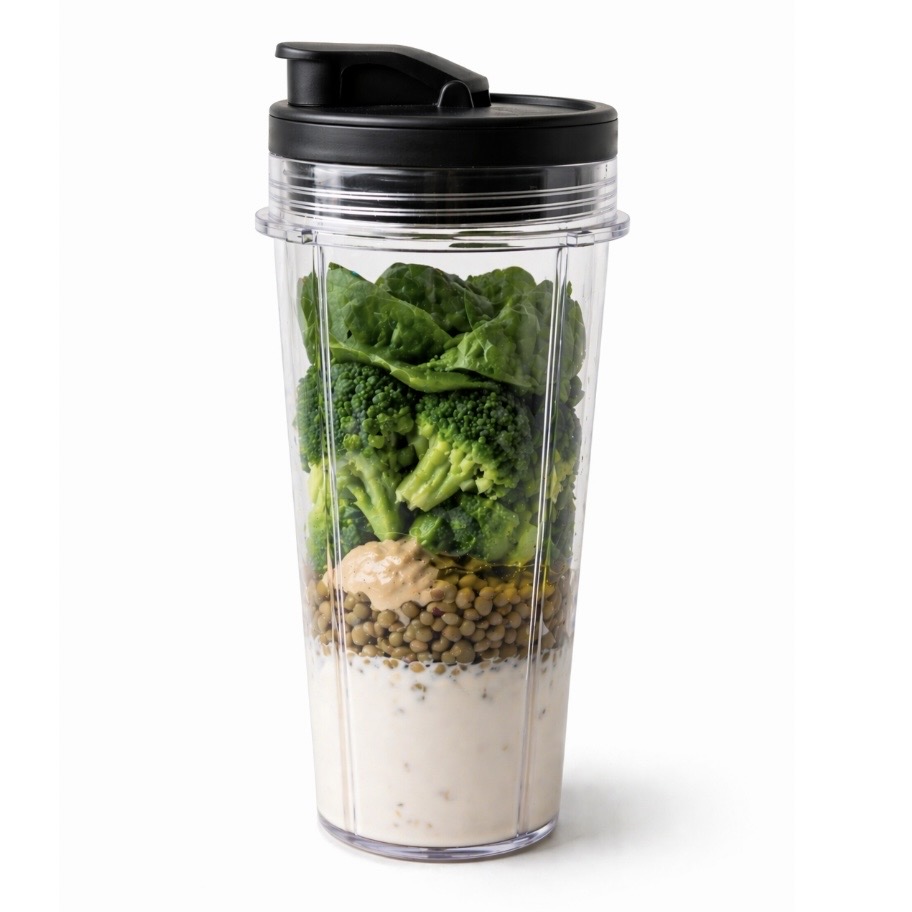
You don’t need expensive kit either. “We started with a really basic blender and have managed ever since without spending a lot of money on a top-of-the-range one,” she says, recommending soaking seeds, steaming hard vegetables, and leaning on tinned fruit and veg as an affordable, already-soft staple.
It’s a familiar gap for anyone who’s blended at home. We bought an expensive blender, not knowing about Kelly’s tips on soaking or steaming — and it still had its own quirks, like the lid suctioning shut on anything hot. At one point, out of guilt that our son wasn’t getting enough proper vegetables on the keto diet, we tried blitzing cottage cheese with double cream and spinach just to see if it would work. There was no guidance like Kelly’s to tell us whether that was even a good idea. That gap is exactly why the demand for her book has been so strong — the need was clearly there long before anyone had written it down.
Do Blended Tube Feeds Need to Taste Good?
“Taste is not a factor for many tube-fed children,” Kelly says, but she’s designed recipes knowing some children can taste their blends orally too. She’s even had messages from adults on blended diets using her recipes, plus one cucumber-and-apple hydration blend that’s become a whole-family favourite in hot weather.
Why Schools and Respite Settings Still Resist Blended Diets
Perhaps the most quietly powerful part of Kelly’s story is about trust. “One of the hardest parts of being a parent carer isn’t necessarily doing everything yourself, it’s trusting someone else to do it,” she says. “We hold so much information in our heads that it can be difficult to pass on”. That’s exactly why she designed the book to be handed to PAs, respite staff or family — so parents can let go of feeding duties with more confidence.
The wider system doesn’t always make that easy. Mason doesn’t attend school, so Kelly’s candid that it’s unfamiliar territory personally — but she’s acutely aware that inconsistent policies across schools, respite and hospitals discourage parents from even starting a blended diet.
“There really needs to be consistent, clear guidance in schools, respite and even hospitals. This has been achieved in other parts of the world so I hope the UK isn’t too far behind”. – Kelly
Kelly’s instinct is backed up by wider evidence. Official guidance confirms that the final decision to allow blended diet in schools, respite care or college ultimately rests with the individual care provider — not the family.
In practice, that leaves many parents with little real choice but to accept what a provider decides, especially when they’re already stretched thin and simply relying on the service to keep their child safe.
Having something concrete and written down — like Kelly’s book — can still make a real difference here, giving parents a tangible resource to bring into those conversations and show a provider exactly what’s being asked of them, rather than relying on verbal explanation alone. There’s already at least one existing parent created resource built specifically to help parents make that case to schools and respite services, and case studies from health boards that have worked collaboratively with schools show it can be done well when everyone’s on the same page.
Parent advocacy shouldn’t have to carry this much weight.
What’s really needed is consistent, national guidance from health bodies, hospices and education providers, so that supporting a blended diet becomes standard practice rather than something each family has to fight for on their own.
Reader Feedback and Amazon Bestseller Success for Kelly’s Book
The book reached number one in both the Children’s & Adolescent’s Foods and Baby Food categories on release day, and has stayed in the top 5–10 of each since. Independent reviews echo what Kelly hears directly from families — one reader called it “lovely,” “beautifully presented” and said she uses it “every day,” adding that it’s useful for other family members too, not just the child being tube fed.
For Kelly, though, it’s the personal messages that stand out most. “Families being grateful for the structure the book provided” is what’s stayed with her — including parents who’d previously tried and failed to start a blended diet, and later succeeded using her book, and others who’ve called it “life-changing”.
Her advice to nervous parents is simple: trust yourself.
Although we can get advice and opinions from medical professionals, ultimately you know your child and what works for them best. There is no right or wrong way and like most things in life practice makes perfect.
For Kelly, the proof is in Mason himself — his colour, his growth, changes in his bowel habits, and an end to the vomiting that once defined their days. “If this book gives one parent the confidence to start, or helps one child feel healthier, every hour I spent writing it was worth it”.
Ready to get started? The Blended Diet Family Recipe Book is available now on Amazon.
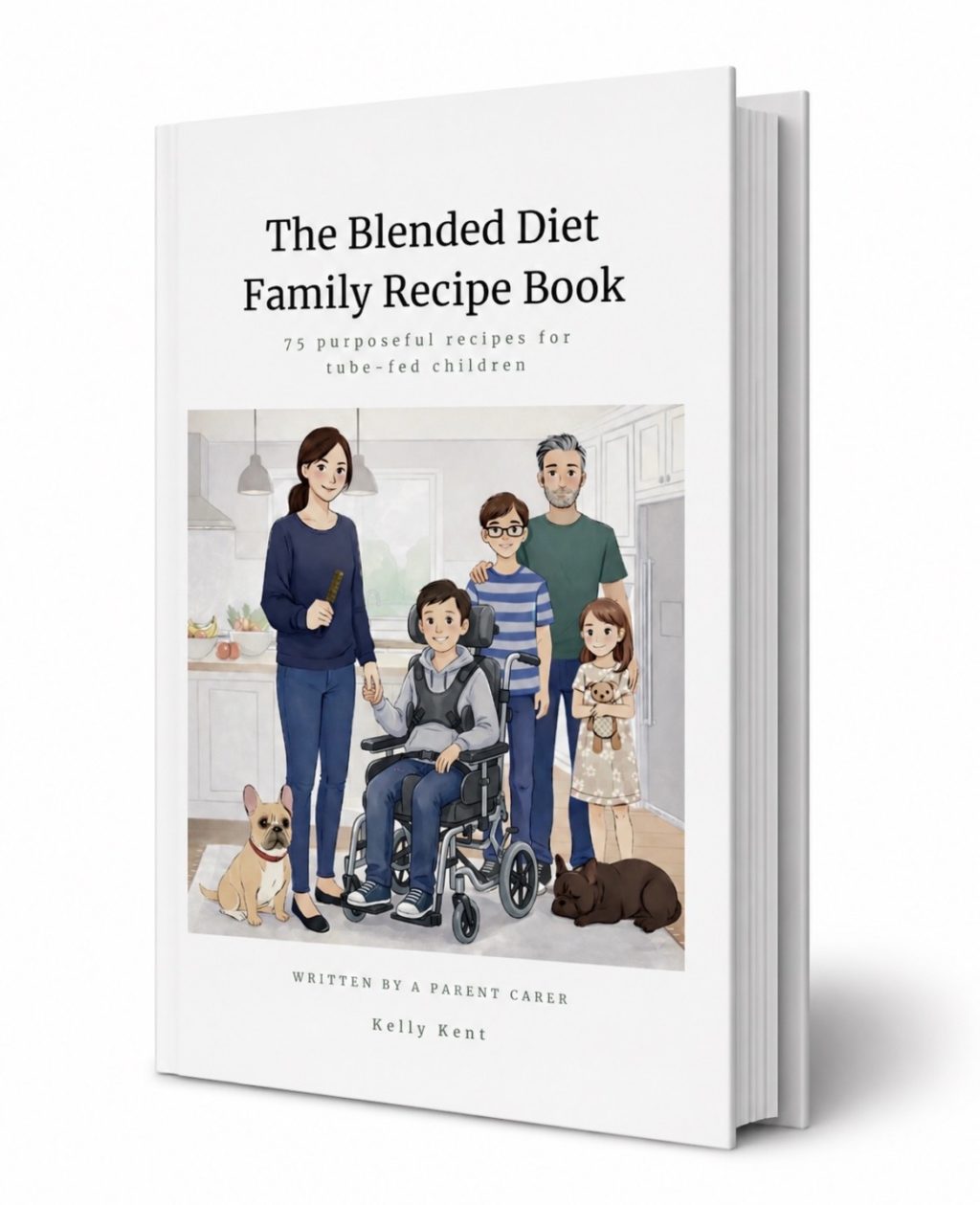
Buy the book here (affiliate link — see disclosure below)
Alongside it, Kelly has also released The Blended Diet Family Feeding Companion — a practical daily log with 80 food charts and 80 symptom-tracking pages, designed to help families track recipes, calories, supplements, water intake and overnight feeds
*Disclosure: Kelly wasn’t paid to be featured, and we weren’t paid to write this. We’re a social enterprise, commercially run and not funded through grants, government or donations — and we believe in supporting disabled entrepreneurs and disabled people and the families and carers who innovate because of an unmet need. People who turn hard-won experience and a gap in provision into something that earns them money. The link above is an Amazon affiliate link; if you buy through it, we may earn a small commission at no extra cost to you, which helps fund more stories like this one.
FAQs about Blended Diets
What is a blended diet for tube feeding?
A blended diet uses ordinary food that has been blended to a smooth consistency and delivered through a feeding tube. It should always be introduced with guidance from an appropriate healthcare professional.
Is blended tube feeding suitable for every child?
No. Every child’s medical needs are different. Decisions about blended diets should be made with healthcare professionals who understand the child’s nutritional and clinical requirements.
Why did Kelly Kent write her recipe book?
Kelly wanted practical guidance written by someone with lived experience after finding that many existing resources were highly technical and difficult for families to use.
Do you need an expensive blender for blended diets?
Not necessarily. Kelly explains that simple preparation techniques such as steaming vegetables and soaking seeds can make many affordable blenders suitable for everyday use.
Why can blended diets be difficult in schools and respite services?
Policies vary between providers. Even where families and healthcare teams support blended diets, schools and respite services may have their own procedures and risk assessments before allowing them.