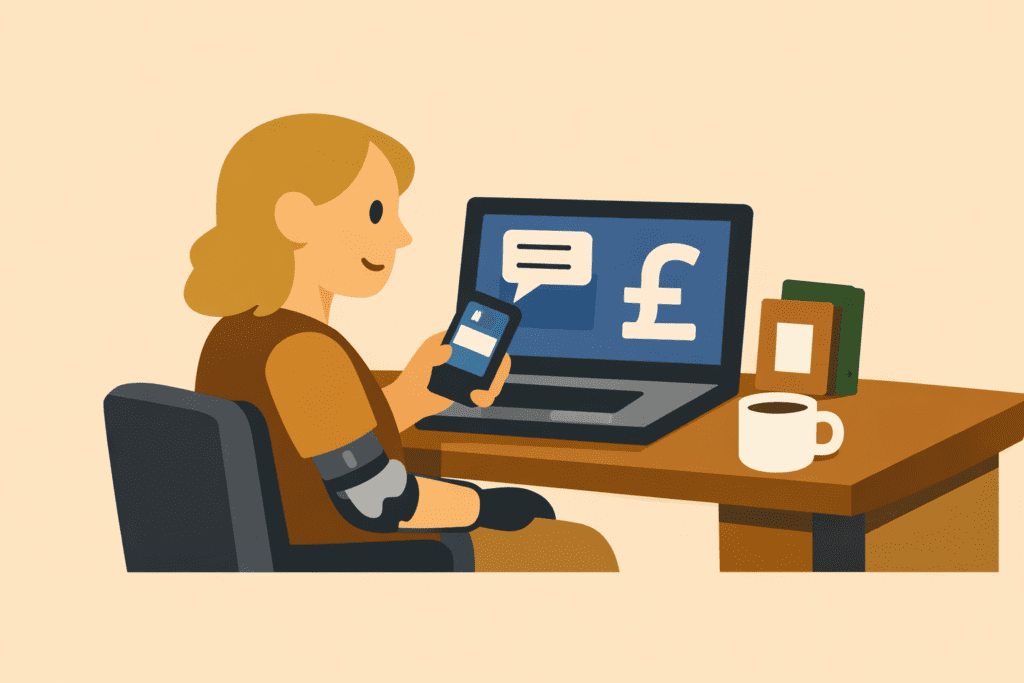
Accessible banking remains a major barrier for many disabled people in the UK. Inaccessible apps, rigid identity checks, biometric login failures, and physical branch access problems can stop people from managing their own money. These barriers affect daily life, from paying carers to running a business.
Research shows disabled entrepreneurs already face significant funding gaps, and financial systems that assume standard work histories or physical access can make those gaps worse. While regulation such as the Financial Conduct Authority’s Consumer Duty requires firms to meet the needs of “vulnerable customers“, many services still fail to meet real accessibility needs.
Better banking design already exists. Multiple login options, screen-reader compatible apps, flexible identity verification, and trained staff can remove many barriers. When financial services recognise disabled people as ordinary customers rather than edge cases, access improves for everyone.
Around 16 million people in the UK live with a disability, yet many financial services are still designed as if disabled customers are rare exceptions.
| Key Point | Why It Matters |
|---|---|
| Many banking systems remain inaccessible | Apps, authentication tools, and branch access can create barriers that stop disabled people managing their own finances. |
| Security features can create unintended barriers | CAPTCHA images, biometric logins, and rigid verification systems do not work for many disabled customers. |
| Financial barriers affect independence | When accounts are locked or services are inaccessible, it can delay payments for carers, transport, or essential bills. |
| Disabled entrepreneurs face additional obstacles | Funding systems and banking processes often assume standard work histories and access to physical branches. |
| Practical accessibility solutions already exist | Screen reader compatible apps, flexible identity verification, trained staff, and multiple login options can remove many barriers. |
Imagine trying to log in to your bank account only to find the security step requires you to read a distorted image you cannot see, or make a phone call you cannot complete. Now imagine running a small business and being told you must visit a branch to verify your identity, a branch with no step-free access and a two-hour round trip by adapted transport.
Accessible banking in the UK remains a significant issue for disabled customers. From inaccessible mobile apps to rigid identity checks and branch access barriers, many financial services still fail to meet basic accessibility needs.
Banking systems support everyday tasks such as paying bills, receiving income, and running businesses. When those systems are designed without accessibility in mind, disabled people can lose time, privacy, and independence.
We experienced this ourselves when starting our business. HSBC issued a small push-button security device for our business account. The buttons were tiny and difficult to press, making the login process slow and frustrating. My wife, Clare, couldn’t use it at all. The design assumed everyone had the dexterity to operate it easily.

That device is now, thankfully, discontinued!
Mobile banking apps now offer secure phone authentication, which removed that barrier. At the time, however, the device was a daily reminder that accessibility had not been considered in the design.
What counts as a banking barrier
The barriers are broader than most people assume, and they stack up fast:
- Inaccessible mobile apps — banking software frequently conflicts with screen readers, and confusing layouts create significant difficulty for neurodivergent users.
- Biometric authentication failures — Face ID, fingerprint scanners, and voice recognition do not reliably work for many disabled people, locking them out of their own accounts.
- Inaccessible telephone banking — automated menus with no British Sign Language option create real barriers for Deaf, speech-impaired, or high-anxiety customers.
- Rigid identity verification — most processes assume standard documents, wet signatures, or branch access. For wheelchair users, housebound people, or those without standard ID, this is a structural wall, not a minor hurdle.
- Fraud detection that punishes disability-related spending — large equipment purchases, multiple carer payments, or bulk medical orders can trigger automated account freezes that take days to resolve.
- Trust account closures — banks have quietly phased out disabled persons’ trust accounts used to hold injury compensation or Direct Payments. WECIL (West of England Centre for Inclusive Living) has documented the devastating impact this has had on people left without a safe structure for essential funds. Metro Bank is now the only high street bank still offering these accounts — and charges a £5 monthly fee unless the balance exceeds £25,000, leaving thousands with extremely limited options.
Accessibility failures are not hypothetical. One blind screen-reader user documented how unlabelled buttons in a banking app announced only “Button. Not pressed.” without context. When they tried to verify their identity, they accidentally selected the wrong option because the controls were inaccessible. The system immediately flagged their account as suspicious, froze their credit card, and locked them out of mobile banking entirely. The only way to recover access was to visit a physical branch — exactly the barrier mobile banking is supposed to remove (UsableNet case study).
Another visually impaired customer described how a forced banking app update left the software almost unusable with their screen reader, saying the new version had effectively “disabled” them from managing their own money. When they reported the issue, the bank replied that they were the only person complaining — a response that many disabled customers will recognise (LinkedIn accessibility post).
The FCA’s Consumer Duty, introduced in 2023, requires firms to deliver good outcomes for all customers — including those in vulnerable circumstances. Yet the FCA’s own 2025 review found that many firms are still not designing products and services to meet a genuine spectrum of needs. The legal floor exists. The practice does not consistently match it.
Why this matters more than you might think
For most people, a blocked payment or inaccessible app is an annoyance. For a disabled person, it can mean missed transport, a delayed food delivery, an unpaid carer, or a bill going into default. Account problems hit harder when income arrives as benefits, Direct Payments, or irregular freelance work, where there is little buffer.
There is also a hidden energy cost. Managing a complaint or working through inaccessible systems is exhausting, made worse for people living with chronic pain, fatigue, brain fog, anxiety, or executive dysfunction. Even relatively simple tasks such as calling support, repeating explanations, or documenting problems can take hours.
The financial backdrop makes this more urgent. ONS data (2023) shows a disability pay gap of up to 17.1% for those limited a lot by their impairment. Research from the University of Bristol found that one-in-three disabled people are currently struggling to make ends meet. Half of disabled people surveyed also reported difficulty accessing bank branches. Ongoing discussions around health and disability benefit reform in 2026 make financial resilience an even more pressing concern — for many households, the margin is already gone.
The impact on disabled entrepreneurs
This is where the problem becomes not just a welfare issue but an economic one that is rarely discussed.
The Lilac Review, a landmark study of disabled entrepreneurship in the UK, found that disabled founders are up to 400 times less likely to secure investment than non-disabled peers. Inaccessible pitch formats, rigid application processes, and assumptions about risk all play a role.
The investment gap is not abstract
A clear recent example came earlier this year, when we wrote about Active Hands’ appearance on Dragons’ Den. The business, an established disability-led company with years of customer loyalty, clinical credibility, and international potential, was framed through disability rather than assessed on its commercial strengths, showing how disabled founders can still be misunderstood even when they arrive with a proven business behind them.
Many disability-led businesses begin because someone experiences a barrier and decides to build a practical solution. A large number of assistive technologies and independence products originate this way, created by disabled people responding to everyday problems that mainstream design overlooked.
Lending and risk models compound the problem further. They are not designed to accommodate the non-linear work histories that are common among disabled people: career gaps, part-time spells, fluctuating income.
The cost of this systemic failure is estimated at £230 billion annually in lost economic contribution from disabled entrepreneurs. A separate study by AlixPartners and Project Nemo found that UK businesses lose a further £70 billion every year simply due to inaccessible payment options — money left on the table because systems were not built to include everyone. In response, the Disability Finance Code for Entrepreneurship, developed with the Department for Business and Trade, UK Finance, and the British Business Bank, was launched in late 2024. Founding signatories include Barclays, HSBC UK, Lloyds, and NatWest.
Identity verification and physical access barriers
Sometimes the barrier is even more direct. In a landmark legal case, wheelchair user David Allen had to discuss private banking matters outside a Royal Bank of Scotland branch because four steps blocked the entrance. He took the bank to court and won a significant accessibility ruling (Disability News Service).
What good accessible banking actually looks like
The solutions are not complicated or expensive. Many already exist in pockets of best practice across the industry:
- Multiple secure login options — not only biometric or SMS-based methods
- Full compatibility with screen readers and voice tools across every banking journey
- Plain English interfaces with clear accessibility settings
- Flexible identity verification — video calls accepted as a reasonable adjustment under the Equality Act 2010
- Human support that is genuinely reachable
- Staff trained in disability confidence
- Carer debit cards available at Barclays, Lloyds, NatWest, Santander, and Starling
- In-branch dementia support, such as Nationwide’s dementia nurse clinics
Scope’s accessible banking guidance explains what disabled customers can ask for as reasonable adjustments.
Practical steps if you are affected
- Ask your bank to log accessibility requirements on your account.
- Document failures. Screenshot errors and record dates and times.
- Use the complaints process. After eight weeks you can escalate to the Financial Ombudsman Service.
- Escalate to the FCA if accessibility failures appear systemic.
- Keep a backup payment method where possible.
- If you are a disabled entrepreneur, ask about accessible onboarding and reference the Disability Finance Code directly when speaking to business banking teams.
Financial access is independence
A step at a shop entrance is immediately visible as a barrier. An inaccessible banking app is invisible to everyone except the person locked out of it. But the result is the same: exclusion from something that others rely on every day.
Banks cannot keep treating disabled people as an afterthought and still claim they are inclusive. Disabled people are customers. They work. They run businesses. They are part of the economy. Treating them as rare exceptions rather than a normal part of the customer base leads to systems that shut people out.
Accessible design should not be treated as a specialist add-on. It should be part of how services are built from the start. When systems are designed so disabled people can use them properly — clearer navigation, flexible identity checks, readable interfaces — the service improves for everyone.
Financial access shapes independence. If banking tools are inaccessible, people may struggle to pay bills privately, manage their own accounts, or set up a business without outside help. The barrier is not the person’s ability. It is the system that assumed a narrow definition of how customers live and work.
When banking systems recognise disabled people as ordinary customers rather than exceptions, access improves. And when access improves, the whole system works better.
Have you faced barriers with banking or financial services? We would like to hear your experiences — share them via email: shop@disabilityhorizons.com