

Before you buy, here’s everything explained in plain English — drawing on real community questions, expert insight from PowerMobility founder Tim Lee, and disabled-led experience from Trabasack and Disability Horizons.
A mobility scooter battery is a rechargeable power source—usually AGM or gel—that determines how far your scooter can travel, how it handles hills, and how reliable it feels day to day.
Key Takeaways
| Topic | What You Need to Know |
|---|---|
| Battery types | AGM, gel and lithium all work differently — check your manual before switching. |
| Compatibility | Size, terminals and capacity must match your scooter model. |
| When to replace | Falling range, slower speed and longer charging times are early warning signs. |
| Upgrading | Larger Ah batteries can extend range if your scooter supports them. |
| Quality matters | The cheapest batteries often wear out faster, costing more long-term. |
| VAT | Most loose batteries are not eligible for disability VAT relief. |
| Helpful tool | PowerMobility’s free Battery Finder shows compatible batteries for your exact model. |
Why Your Battery Matters
A scooter battery has a big influence on daily life. When it’s dependable, it helps people get out, see friends, keep appointments and enjoy being outdoors.
On one holiday, my wife’s powerchair battery started failing halfway through the trip, and our plans shrank around how far we dared the chair to go, rather than the places we had intended to visit. It was frustrating to be unexpectedly let down by equipment we depended on.
A good battery supports the scooter to:
- Keep a steady pace
- Manage hills without slowing
- Deliver the range you expect
- Avoid unexpected shutdowns
Signs You Need to Replace Your Mobility Scooter Battery
Scooter batteries usually give advance warning. Common signs include:
- Shorter range
- Slower acceleration
- Longer charging times
- Weaker hill performance
- The scooter stopping without warning
- A charger that turns green immediately because the battery can’t accept charge
Most scooters run on a 24V system, using two 12V batteries together. When one weakens, the pair becomes unstable — which is why replacements should always be fitted as a matched set.
Choosing the Right Type of Mobility Scooter Battery
Scooters typically use one of three battery types:
AGM batteries
Sealed and maintenance-free. These are the most common in the UK and suit everyday use.
Gel batteries
They cope well with deep discharge and are approved for air travel. Some long-range scooters use gel as standard.
Lithium batteries
Lightweight and long-lasting, but only suitable if the scooter is built for lithium systems. A lithium upgrade is not a drop-in replacement for AGM or gel unless your manufacturer says so.
Before ordering anything, check your manual or ask the retailer to confirm compatibility.
How to Find the Correct Size and Fit
The most confusing part of buying replacement batteries is the sizing. Batteries that look similar can differ in capacity (Ah), height and width, terminal style, and terminal orientation.
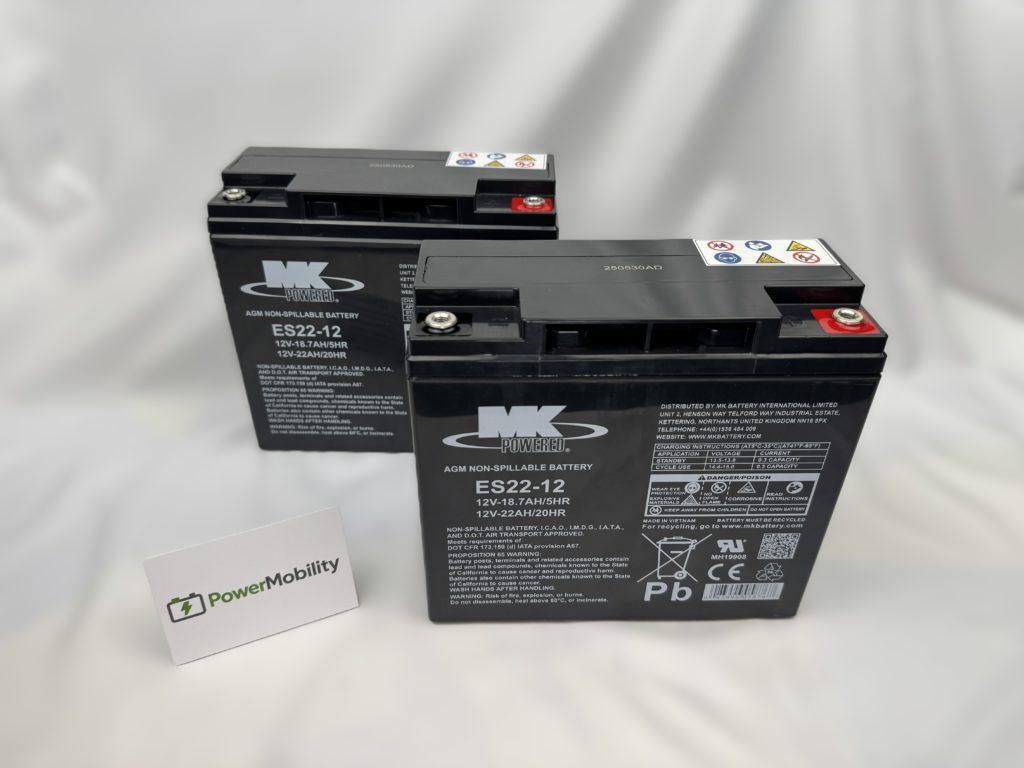
Common sizes include 12Ah, 14Ah, 17Ah, 22Ah, 33Ah, 35Ah, 50Ah and 100Ah. If the height is a few millimetres off, the battery may not fit the scooter box at all.
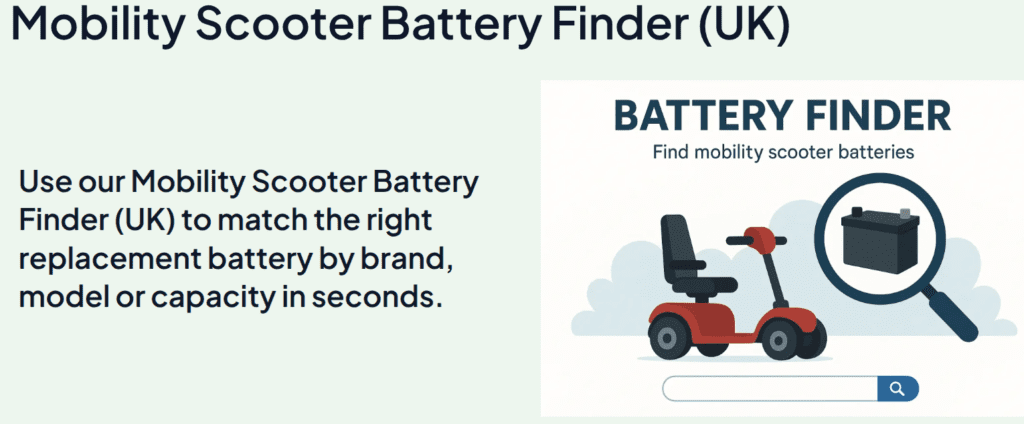
To remove the guesswork, the PowerMobility Battery Finder lets you select your scooter model and see compatible batteries instantly — avoiding wrong orders and returns.
Why the Cheapest Batteries Often Cost More
Price matters when buying replacement batteries — but focusing only on the lowest upfront cost can lead to higher expenses over time.
Fewer charge cycles
Budget batteries typically last 6–12 months rather than 18–24 months, meaning you replace them twice as often.
Lower real-world capacity
A cheap “33Ah” battery might perform more like a 22Ah in actual use, resulting in shorter range and more frequent charging.
Poor-quality terminals and internal components
These can cause voltage drops, random shutdowns, or difficulty holding charge — limiting where you can travel confidently.
Weak cold-weather performance
Lower-grade materials react badly to UK winters, reducing range precisely when you need reliability most.
Impact on independence
Planning every trip around battery anxiety, or getting stranded, costs far more than the price difference between budget and mid-range batteries.
A reliable, well-made battery pair tends to last longer, perform more consistently and protect your scooter’s electronics. For daily users, a solid mid-range AGM battery often works out cheaper per year than the lowest-priced option.
What Mobility Scooter Users Ask Most Often
“My scooter was unused for months — are the batteries ruined?”
AGM batteries don’t cope well with sitting partially discharged for long periods. They may still work, but range is often reduced. A careful test run or professional load test can confirm whether they’re still healthy.
“Can I buy a cheaper battery with lower Ah?”
Lower Ah always means shorter range. The battery still must match the scooter’s physical size, terminal type and current-draw requirements — so “any 12V” battery won’t do.
“My new batteries don’t feel new — should I return them?”
Manufacture date, storage conditions and the first few charge cycles all affect performance. If the range is far below what your scooter should deliver, returning them is reasonable.
“Should I switch to lithium?”
Lithium (often LiFePO₄) can give much better usable capacity, but only if your scooter is designed for it. Without manufacturer approval, it can be unsafe.
“Why does my powerchair range keep dropping even with branded batteries?”
Sometimes the batteries aren’t the issue. Chargers, wiring, connectors, firmware settings and inaccurate LED meters can all cause poor range.
How to Upgrade Your Mobility Scooter Battery for Better Range
Some scooters allow a capacity upgrade — for example 22Ah to 33Ah/35Ah, or 33Ah to 50Ah. A higher-capacity battery can increase range if your scooter’s battery box and controller can support the larger size. This helps if:
- Your current range feels too limited
- You often deplete the batteries fully
- You travel long distances
- Cold weather affects your range
If you’re unsure, PowerMobility can check compatibility for you at no cost.
VAT: What You Need to Know Before Buying
Most mobility scooter batteries are not VAT-exempt. Loose AGM and gel batteries are treated as general-use products, even when bought for a mobility scooter, so they are normally charged at the standard VAT rate.
VAT relief only applies in rare cases — if the battery is designed solely for disabled use and supplied as part of a qualifying repair or equipment package. Most standard AGM batteries won’t meet that definition.
For full details, see the Disability Horizons VAT guide.
Charging and Maintenance Tips to Extend Battery Life
- Charge after each outing
- Use the charger designed for your scooter
- Avoid storing the scooter on low charge
- Keep batteries warm and dry during winter
- Never mix old and new batteries
- Recycle batteries at approved centres
Getting Help If You’re Unsure
Many disabled people find technical language around batteries inaccessible — and that’s understandable. If you want reassurance before ordering, PowerMobility offers free phone and email support, and the Battery Finder tool removes most of the uncertainty.
Frequently Asked Questions
How long do mobility scooter batteries last?
Most batteries last between 12 and 24 months, depending on frequency of use, charging habits, and terrain. Daily users may need replacements more frequently; occasional users may get longer life.
What type of battery does my mobility scooter need?
Most scooters use two 12V sealed lead-acid batteries — either AGM or gel. The correct Ah rating and terminal type vary between models.
Can I upgrade to a larger battery for more range?
Yes — many scooters support upgrades from 22Ah to 33Ah, or from 33Ah to 50Ah. Always check compatibility with the battery box and controller before upgrading.
Are the cheapest batteries worth buying?
Not always. Cheap batteries often have shorter lifespans, lower real-world performance and weaker internals. A mid-range or premium battery usually works out more economical long-term.
Are mobility scooter batteries VAT-exempt?
Most replacement AGM or gel batteries are standard-rated, as they’re classed as general-use products. VAT relief only applies to parts designed solely for disabled use.
How far can a mobility scooter go on a full charge?
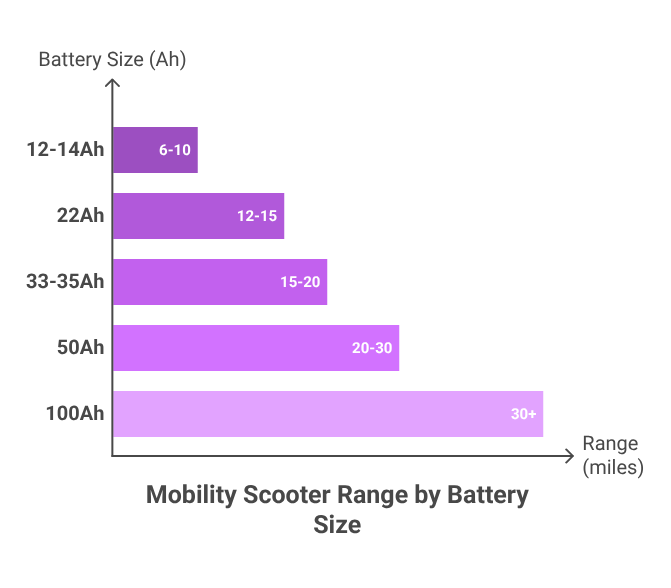
As a rough guide: 12–14Ah gives 6–10 miles; 22Ah gives 12–15 miles; 33–35Ah gives 15–20 miles; 50Ah gives 20–30 miles; 100Ah gives 30+ miles.
Do batteries need to be replaced as a pair?
Yes. Scooters run on a 24V system — both 12V batteries work together. Mixing an old battery with a new one leads to uneven performance and shortens both batteries’ lives.
How do I dispose of old mobility scooter batteries?
Never put them in household waste. Most council recycling centres, mobility shops and garages accept lead-acid batteries for free.
What’s the quickest way to find the right battery for my scooter?
Use the free PowerMobility Battery Finder — it shows correct battery sizes and terminal types for your model.
About Tim Lee – founder of Power Mobility

Tim has over 15 years of experience as an Occupational Therapist and NHS manager in rehabilitation and community mobility services. After seeing how confusing and inconsistent mobility battery advice can be for disabled people, carers and families, he created Power Mobility — a UK-based service offering trustworthy information, compatible battery guides, and reliable replacement batteries for mobility scooters.
“Not sure which mobility scooter battery you need? This plain-English guide covers AGM, gel and lithium, plus the warning signs to look out for.”
“Replacing a mobility scooter battery shouldn’t mean guessing. This guide explains battery sizes, Ah, compatibility and when it’s time for a new pair.”
Shorter range, slower speed, longer charging times? These can all point to a failing mobility scooter battery. Here’s what to check before you buy.